
Introduction
Degenerative myelopathy (DM) is a slow, painless disease of the spinal cord that gradually takes away an older dog's ability to use the back legs. It usually starts between 8 and 14 years of age with a wobbly, weak walk and dragging back toes. Over about a year it often leads to hind-leg paralysis. There is no cure, but physical therapy, good home care and early planning can help your dog stay comfortable for as long as possible.
Key Takeaways
- Degenerative myelopathy in dogs is a progressive spinal cord disease that is often compared to ALS in people. It is not painful.
- Signs usually appear between 8 and 14 years of age: a swaying walk, scuffed or knuckled back paws, and trouble standing up.
- Many dogs lose the ability to walk on their back legs within about a year of the first signs.
- A DNA test for the SOD1 gene shows risk, not disease. Vets diagnose DM by ruling out other spinal problems.
- Daily physical therapy, harnesses, carts and careful skin and bladder care can keep dogs mobile and comfortable for longer.
- Planning a gentle goodbye before a crisis, ideally at home for a dog who can no longer walk, can spare your dog stress and pain from complications.
If your senior dog has started to sway, stumble or drag a back foot, it is natural to wonder whether it is arthritis, a slipped disc or simply old age. This guide explains what degenerative myelopathy is, how it progresses through its stages, how vets diagnose it, how to care for your dog at home, and how to know when it may be time to say goodbye.
What Is Canine Degenerative Myelopathy?
Degenerative myelopathy is a progressive disease in which the nerve fibers of the spinal cord slowly break down. Vets see this degeneration of the spinal cord in its white matter, the bundles of fibers that carry messages between the brain and the hind limbs. As those signals weaken, the back legs gradually lose coordination and strength. An older name for the condition is chronic degenerative radiculomyelopathy. The disease was first described in 1973 in aging German Shepherd Dogs. It is now known in many breeds, according to the University of Missouri Veterinary Health Center, where much of the research on DM has been done.
Canine degenerative myelopathy always starts in the hind legs. Over time it moves forward to the front legs. In its late stages it can affect swallowing and breathing. Because it advances in one direction only, it helps to understand early on where it is likely to lead.
Is Degenerative Myelopathy Painful for Dogs?
No. Degenerative myelopathy itself is not painful, and dogs with DM do not appear to feel pain from the disease. This is one of the main ways vets tell it apart from a disc problem, which usually hurts. However, many older dogs with DM also have arthritis, and dragging feet can cause sore, scraped toes, so your dog can still have discomfort from other causes. Tell your vet if your dog seems sore, so it can be treated.
How Is DM in Dogs Similar to ALS in People?
In 2009, researchers linked DM to a genetic mutation in a gene called SOD1. Inheriting two copies of the gene change is a major risk factor, although it does not mean a dog will definitely become ill. Changes in the same gene cause some forms of ALS (amyotrophic lateral sclerosis, or Lou Gehrig's disease) in people. Both diseases start in adulthood, cause steadily worsening muscle weakness and have no cure. For this reason, dogs with DM are also studied to help understand ALS.
Which Dogs Get Degenerative Myelopathy?
DM is a disease of older dogs. The Orthopedic Foundation for Animals (OFA) says signs usually appear between 8 and 14 years of age, and some dogs show no signs until age 15. Smaller breeds tend to develop signs later than larger ones. German Shepherds, Boxers, Pembroke Welsh Corgis and Bernese Mountain Dogs are among the dog breeds most often linked to DM.
The OFA lists 30 breeds with proven risk. Some of the best known are:
| Breed group | Examples of breeds at risk |
|---|---|
| Herding breeds | German Shepherd Dog, Pembroke and Cardigan Welsh Corgi, Australian Shepherd, Collie, Shetland Sheepdog |
| Working breeds | Boxer, Bernese Mountain Dog, Siberian Husky, Komondor |
| Sporting breeds | Golden Retriever, Labrador Retriever, Chesapeake Bay Retriever, English Springer Spaniel |
| Other breeds | Rhodesian Ridgeback, Poodle, Pug, Cavalier King Charles Spaniel, Wire Fox Terrier |
Mixed-breed dogs can carry the gene change too, though the disease is less often seen in them. Older dogs of breeds such as Chesapeake Bay Retrievers, Rhodesian Ridgebacks, Cardigan Welsh Corgis and Wire Fox Terriers are also at higher risk. If your dog is one of these breeds and is getting older, it is worth learning the early signs.
What Are the Early Signs of Degenerative Myelopathy in Dogs?
The first clinical signs of degenerative myelopathy are easy to mistake for normal aging or arthritis, because they come on slowly and do not hurt. Most begin with a loss of coordination in the hind legs. Watch for:
- A swaying or wobbly back end when walking, as if your dog is a little drunk
- Hind paws scuffing the ground, with worn or bleeding nails on the back toes
- Knuckling, where a back paw folds under so your dog stands on the top of the foot
- Back legs crossing over each other or stepping too wide
- Difficulty standing up from a lying position, or slipping on smooth floors
- Falling over when turning, or when you gently push on the hips
- Signs that are worse on one side at first
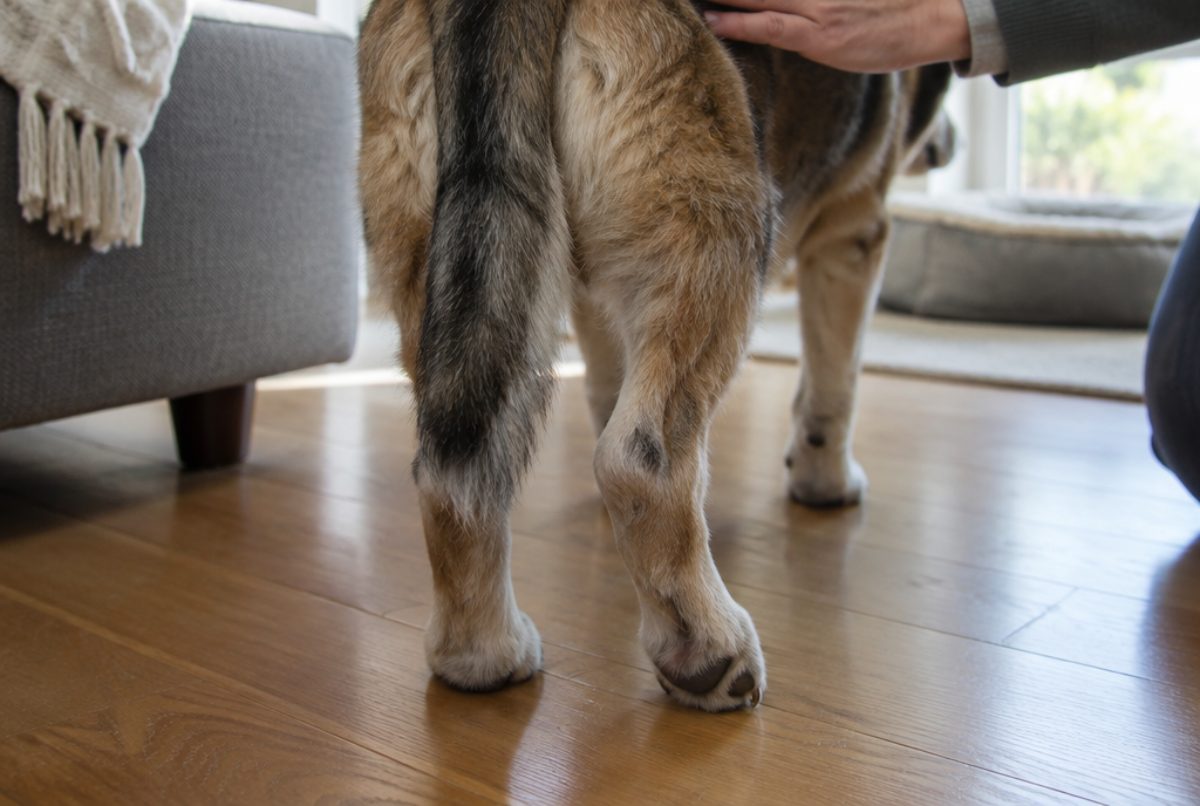
If you see any of these signs, book a visit with your veterinarian. Some conditions that look like DM, such as a disc problem, can be treated, so an early check really matters.
What Are the 4 Stages of Degenerative Myelopathy?
Vets often describe DM in four stages. The time a dog spends in each stage varies, and not every dog moves through them at the same pace. This table, based on the stages described by PetMD and the University of Missouri, shows what to expect.
| Stage | What you may see |
|---|---|
| Stage 1: Early | Your dog can still walk but sways, knuckles, drags the back toes and has trouble rising. |
| Stage 2: Moderate | Your dog can no longer walk on the back legs without help and may or may not be able to stand on them. |
| Stage 3: Advanced | The back legs are paralyzed and their muscles shrink. Your dog has loss of bladder and bowel control (urinary and fecal incontinence), and the front legs start to weaken. |
| Stage 4: Late | All four legs are paralyzed, with muscle loss throughout the body, a changed bark, and trouble swallowing and breathing. |
Most families make the decision to say goodbye during stage 2 or stage 3, as the loss of mobility grows and long before the final stage. We explain why later in this guide.
How Long Do Dogs Live With Degenerative Myelopathy?
The progression of the disease differs from dog to dog, but the general pattern is well known:
- The OFA says signs typically worsen over six months to a year, leading to hind-leg paralysis.
- The University of Missouri notes that many affected dogs can no longer walk within 11 months of the first signs.
- PetMD puts the time from first signs to the point where quality of life becomes a real concern at about 6 to 18 months.
- Small dogs are easier to lift, carry and nurse, so they often live longer with DM than large dogs.
Physical therapy seems to make a real difference. In a 2006 study of dogs with suspected DM, published in the Journal of Veterinary Internal Medicine, dogs that had intensive daily physiotherapy lived for an average of 255 days. Dogs with moderate physiotherapy lived for 130 days, and dogs with none for 55 days. The study was small (22 dogs in this comparison), but it is a good reason to start therapy early.
Tip: Keep a short note on your phone each week: how far your dog walked, how often they fell, and whether they could get up alone. Small changes are easy to miss day to day, and this record helps your vet see how fast the disease is moving.
How Is Degenerative Myelopathy Diagnosed?
There is no single test that confirms DM in a living dog. A definitive diagnosis is only possible by examining the spinal cord under a microscope after death. In practice, the diagnosis of DM is reached by ruling out other causes with a series of diagnostic tests. That usually includes:
- A full physical and neurological exam to check reflexes, coordination and where the problem sits in the spinal cord, plus blood work to check general health.
- X-rays of the spine and hips to look for arthritis, hip dysplasia, bone problems or tumors (the spinal cord itself does not show on X-rays).
- MRI, a CT scan or a myelogram to look for compression of the spinal cord, such as a disc problem or a tumor, or for inflammation.
- Spinal fluid analysis in some cases, where a small sample of cerebrospinal fluid is checked to rule out inflammation or infection.
- A DNA test for the SOD1 gene, which adds support when the other tests are clear.
What Do DM DNA Test Results Mean?
Genetic testing uses a cheek swab or a blood sample. It shows whether your dog carries the SOD1 change, but it cannot say whether your dog will become ill. Here is how the OFA explains the results:
| Result | What it means |
|---|---|
| Normal (N/N) | Two normal copies of the gene. DM is very unlikely. |
| Carrier (A/N) | One changed copy. Carriers are far less likely to develop DM, though a few cases have been confirmed. |
| At risk (A/A) | Two changed copies. Almost all confirmed DM cases have this result, but many at-risk dogs never develop the disease. |
So an "at risk" result in a dog with typical signs supports a DM diagnosis, but on its own it is not proof. A normal result makes DM very unlikely and points your vet toward other causes. DM cannot be prevented in a pet dog, but breeders use DNA testing to lower the risk in future litters.
What Conditions Can Look Like DM?
Several spinal and joint problems can cause similar back-leg weakness, which is why ruling them out matters so much. They include intervertebral disc disease (IVDD), arthritis and hip problems, lumbosacral disease in the lower back, tumors of the spine or spinal cord, and inflammation of the spinal cord. Unlike DM, many of these cause pain, and some can be treated with medicine or surgery.
Can Degenerative Myelopathy Be Treated?
There is currently no cure for degenerative myelopathy and no medicine proven to stop it. Treatment is palliative care: it focuses on keeping your dog strong, mobile, clean and comfortable, with the best quality of life for as long as possible. The Cornell Richard P. Riney Canine Health Center notes that routine physical therapy may slow the disease.
Physical Therapy and Gentle Exercise
Ask your vet about a referral to a veterinary rehabilitation therapist. A plan for dogs with DM often includes:
- Short, regular walks on grass or carpet, rather than one long walk
- Underwater treadmill or swimming sessions, which build strength without strain
- Range-of-motion exercises and stretches you can do at home
- Gentle massage to help tight muscles and circulation
Exercise and physical therapy help an affected dog keep muscle mass for longer. Keeping your dog at a healthy weight also means less load on weakening legs.
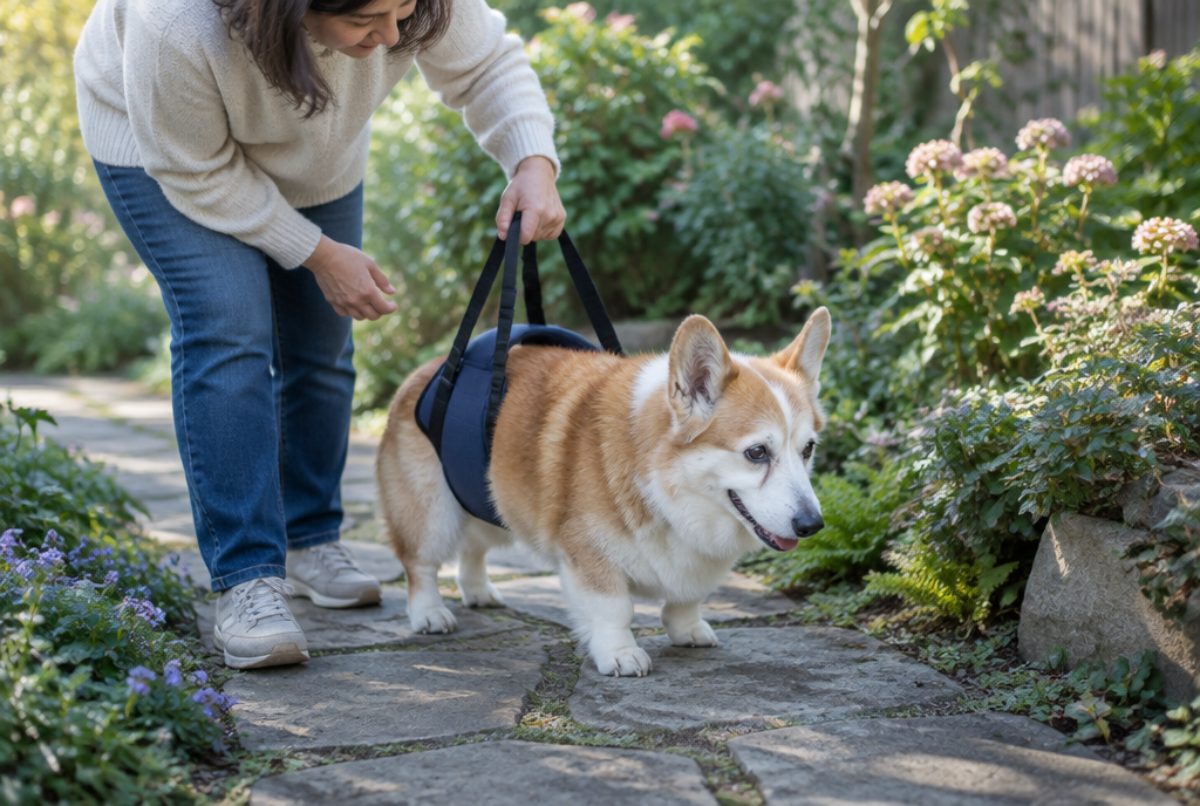
Harnesses, Carts and Safer Floors
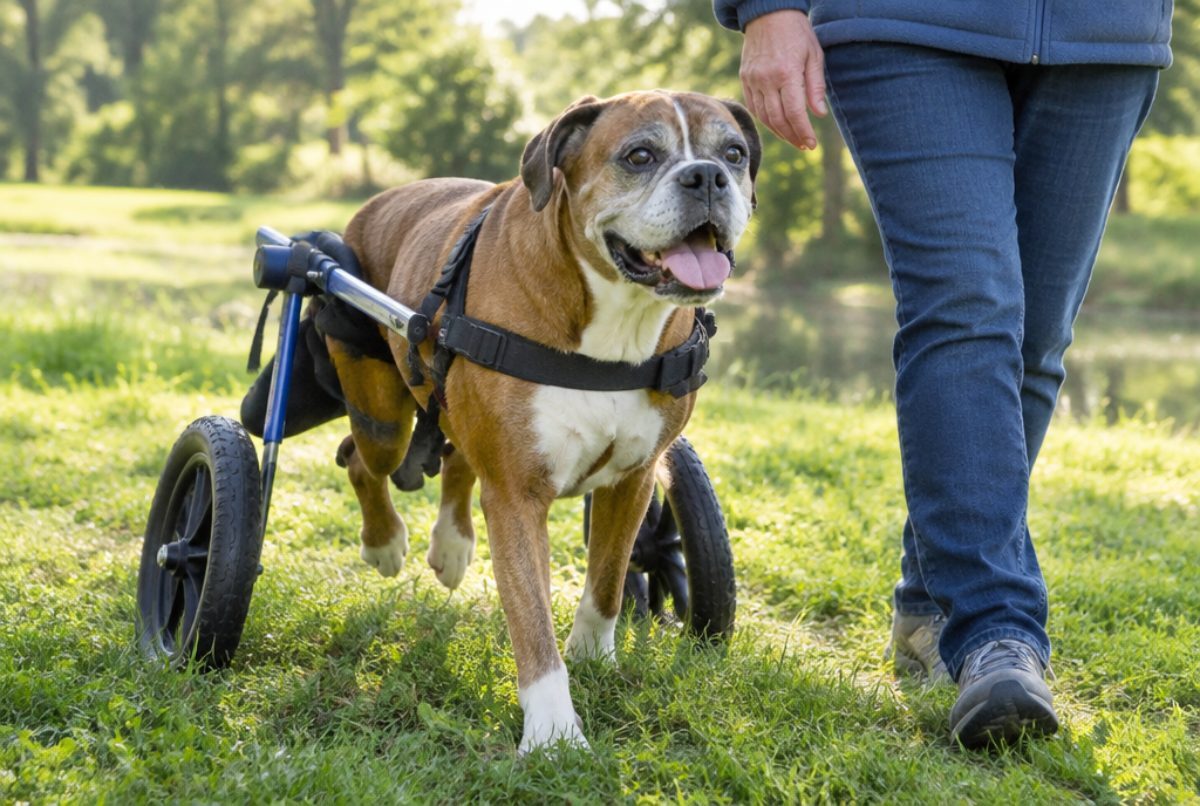
As the back legs weaken, a rear support sling or a full-body harness with a handle lets you help your dog stand, walk and climb steps. Later, a mobility cart (dog wheelchair) can give back a lot of freedom. Many dogs take to one quickly and enjoy walks again. Use a cart only while you can watch your dog.
At home, lay rugs or yoga mats on smooth floors, block stairs, and use rubber booties or toe grips to protect the back paws from scraping. Keep nails short so the toes do not catch.
Bladder, Skin and Bedding Care
Once your dog cannot walk, nursing care becomes the biggest part of the day. The University of Missouri and PetMD recommend:
- A clean, thickly padded bed, plus extra padding under the head and between the legs
- Turning your dog from side to side every 4 to 6 hours if they cannot move on their own, to prevent pressure sores
- Emptying the bladder three times a day, by gentle expression or a catheter (your vet can show you how), once your dog can no longer urinate alone
- Keeping the skin clean and dry, and watching for urinary tract infections
- Wraps or booties and wound care for toes that are scuffed raw
This care is a real act of love, and many pet parents find it is also hard work, especially with a large dog. It is fine to say honestly what you can and cannot manage. Our guide on supporting senior dogs with mobility loss has more ideas for daily comfort.
When to Put Down a Dog With Degenerative Myelopathy
Knowing when to put down a dog with degenerative myelopathy is one of the hardest decisions a family can face. There is no single right moment, and because DM does not hurt, many dogs stay bright and happy even as their bodies fail. Most families decide when the disease starts to take away their dog's comfort and dignity, or when the care needed goes beyond what the household can safely give. Signs it may be time include:
- Your dog can no longer stand or move, even with a sling or cart
- Pressure sores, skin scalds from urine, or bladder infections that keep coming back
- Loss of bladder and bowel control that leaves your dog distressed or unable to stay clean
- Weakness spreading to the front legs, so your dog cannot shift position, sit up to eat or drag themselves to you
- Trouble swallowing, coughing while eating or drinking, or any change in breathing
- Your dog seems frustrated, anxious or withdrawn, and no longer enjoys the things they used to love
- You can no longer lift, turn or clean your dog safely, or caring for them is harming your own health
"Choosing a peaceful goodbye while your dog can still enjoy your company is not giving up. It is a way of protecting them from the hardest part of this disease."
Large dogs are often helped to a peaceful end once they can no longer walk, because turning, lifting and cleaning a big dog safely becomes so difficult. Smaller dogs may stay comfortable longer with good nursing care. Both choices can be loving ones.
A Weekly Quality-of-Life Check
A quality-of-life scale can make a blurry feeling clearer. One widely used tool is veterinarian Dr. Alice Villalobos's HHHHHMM quality-of-life scale (also written 5H2M), which scores seven areas from 0 to 10: hurt, hunger, hydration, hygiene, happiness, mobility, and more good days than bad. A total above 35 is generally seen as an acceptable quality of life. For a dog with DM, pay special attention to these areas:
| Area | Questions to ask each week |
|---|---|
| Mobility | Can my dog change position, get to food and water, and come to me, with or without help? |
| Hygiene | Can I keep my dog clean and dry? Are there sores, scalds or infections? |
| Hunger and hydration | Is my dog eating and drinking well, and swallowing without coughing? |
| Happiness | Does my dog still greet us, enjoy treats, toys or time outside, and seem calm? |
| Good days vs. bad days | Over the past week, have there been more good days than hard ones? |
A simple calendar works too: mark each day as good or hard. When the hard days start to outnumber the good ones, it is time to talk with your vet.
Questions to Ask Your Vet
- Which stage do you think my dog is in, and how quickly is it moving?
- Is there anything else, such as arthritis or an infection, causing discomfort that we can treat?
- What signs would tell us my dog's quality of life is no longer good?
- What can we do if my dog's front legs or swallowing start to be affected?
- Could we plan a goodbye at home, so my dog does not need to be moved?
If you would like an unhurried conversation focused only on comfort and planning, Honor Pet offers one-hour quality of life consultations with a licensed veterinarian, virtually or in person.
Saying Goodbye Before a Crisis
With DM, waiting for an emergency often means waiting for something painful, such as a bad pressure sore, an infection or trouble breathing. Many families find peace in choosing a calm day instead, while their dog can still enjoy a favorite meal, a sunny spot and the people they love.
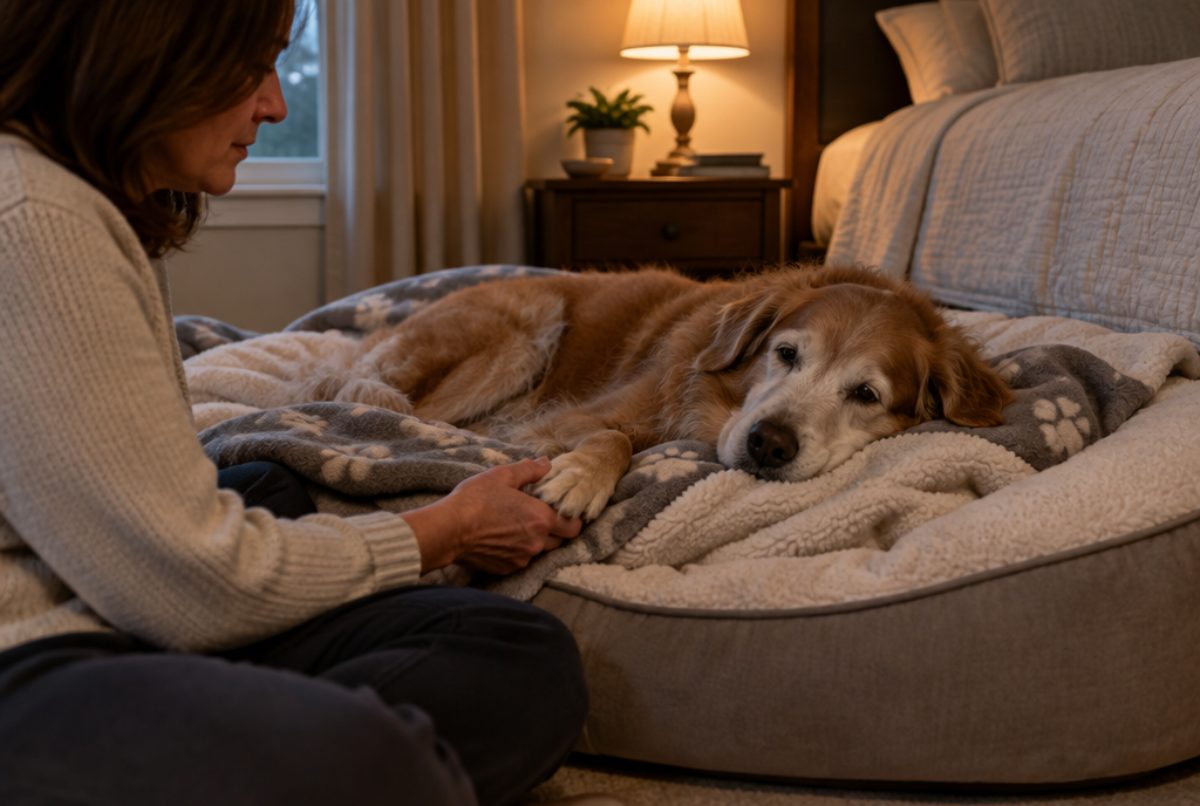
For a dog who can no longer walk, an in-home euthanasia visit can be especially kind. There is no lifting a heavy dog into a car and no stressful clinic waiting room. Your dog can rest in their own bed with the family close by.
Honor Pet's veterinarians provide in-home euthanasia throughout Los Angeles and surrounding areas, and gentle goodbyes in private, home-like rooms at our Comfort Center in downtown Los Angeles. Appointments are available 7 days a week, and same-day visits are often possible. In-home euthanasia is $550 and a Comfort Center appointment is $300.
During the appointment, your dog first receives a calming sedative so they can relax into a deep sleep. Only then is a second medication given, which lets the heart stop peacefully. You can stay close, talk to your dog and take as much time as you need.
Aftercare, Memories and Support for Your Family
After the goodbye, Honor Pet can take care of your dog with water cremation, a gentle process that uses 90% less energy than fire cremation. Individual cremation, with ashes returned to you, is $349 for dogs under 20 lb, $399 for dogs 20 to 80 lb and $449 for dogs over 80 lb. Communal cremation is $180, $205 or $232 by the same weights. With individual cremation, the ashes come back in the Honor Box, which includes a scatter tube, a digital nose print, a fur clipping in a glass vial, seeds, a candle and a certificate.
Living with a disease like DM means many families start grieving long before the goodbye. Honor Pet's pet loss support is led by a licensed clinical social worker and includes free weekly virtual support groups, so you do not have to carry it alone.
Is degenerative myelopathy changing your dog's life?
Our veterinarians can help you understand your dog's quality of life and plan a gentle goodbye when the time comes, at home or at our Comfort Center.
Talk to Honor Pet or call (323) 515-1234
Frequently Asked Questions
Is degenerative myelopathy painful for dogs?
No. Degenerative myelopathy itself is not painful. Dogs can still have discomfort from other problems, such as arthritis, scraped toes or pressure sores, so ask your vet to check and treat these.
How long can a dog live with degenerative myelopathy?
It varies, but many dogs lose the use of their back legs within about 6 to 12 months of the first signs. Quality of life often becomes a real concern within 6 to 18 months. Daily physical therapy, a cart and careful nursing can help some dogs, especially small dogs, stay comfortable for longer.
Can a DNA test tell me if my dog will get DM?
Not for certain. The SOD1 DNA test shows whether your dog is normal, a carrier or at risk. Most dogs with DM test "at risk", but many at-risk dogs never develop the disease. The test is most useful alongside a vet exam that rules out other causes.
Can degenerative myelopathy be prevented, cured or slowed?
DM cannot be prevented in a pet dog, and there is no cure or medicine proven to stop it. Breeders can lower the risk in future puppies by DNA testing parent dogs. For a dog who already has DM, regular physical therapy is the best-supported way to help. In one study, dogs with intensive daily physiotherapy lived much longer on average than dogs without it.
What is the last stage of degenerative myelopathy?
In the final stage, all four legs are paralyzed, muscles waste away throughout the body, and the dog has trouble swallowing and breathing. Most families choose a peaceful goodbye before this stage, to spare their dog these hardest changes.
How much does pet euthanasia cost with Honor Pet?
In-home euthanasia with Honor Pet is $550, and a goodbye at our Comfort Center in downtown Los Angeles is $300. Water cremation starts at $180 for communal cremation and $349 for individual cremation, depending on your dog's weight.
If you would like to keep a lasting memory of your dog, a clay paw print ($40) or a fur clipping ($7.50) can preserve a small, touchable part of them. You can also choose from wood and bamboo urns from $25 in the Honor Pet memorial store.