
Introduction
Yes, it is very common for an old dog to go deaf. Age-related hearing loss usually starts in the last third of a dog's expected lifespan, takes away high-pitched sounds first and slowly gets worse. The clearest signs are that your dog sleeps through noises that used to wake them, stops coming when called and is easily startled. A vet check matters, because some hearing loss comes from ear infections or blockages that can be treated, and most deaf senior dogs live happily with hand signals and a few changes at home.
Key Takeaways
- Hearing loss is common in older dogs and often develops so slowly that owners miss the first signs.
- Common changes include sleeping through familiar sounds, not coming when called, barking more, and startling when touched.
- To tell if your dog is deaf, make a familiar sound out of sight while they rest. A dog who never wakes or turns an ear is a strong sign of hearing loss in both ears.
- Earwax, ear infections and a damaged eardrum can muffle hearing, and hearing often returns once they are treated. Age-related hearing loss is permanent.
- Sudden deafness, especially with a head tilt, circling or pain, needs a vet visit soon.
- Deafness is not painful. With safety steps, hand signals and a steady routine, most deaf dogs keep a good quality of life.
Hearing loss in an older dog can feel upsetting at first, especially if your dog has always turned at every sound. Still, a change in hearing does not mean your companion cannot enjoy comfort, connection and a good life. Many dogs adapt very well. This guide explains how to tell if your dog is deaf, why older dogs lose their hearing, what your vet can check, and how to keep a deaf dog safe, confident and close to you.
What Are the Most Common Signs That My Senior Dog Might Be Going Deaf?
The main sign of deafness is simply not responding to sound. The Merck Veterinary Manual lists failing to wake or alert to a noise as the key sign, along with barking more, voice changes, hyperactivity, confusion with voice commands and less ear movement. In older dogs, gradual hearing loss often shows up as a dog who no longer comes when called.
Because age-related hearing loss takes away middle and high-pitched sounds first, many dogs still respond to loud or deep sounds for a while. Your dog may ignore your voice or a squeaky toy but still jump at a slammed door. That pattern makes loss of hearing hard to spot, and it is why many families only notice once it is quite advanced.
| What you may notice | Why it can point to hearing loss |
|---|---|
| Sleeps through the doorbell, your arrival home or a food bag rustling | A sleeping dog who does not wake to a sound they cannot see or feel is one of the strongest signs of deafness in both ears |
| Stops coming when called, especially from another room | Your voice no longer reaches them, so it can look like stubbornness |
| Startles or snaps when touched from behind | They did not hear you coming |
| Barks more, or their bark sounds louder or different | Voice changes and extra barking are listed signs of deafness |
| Ears no longer swivel toward sounds | Less ear movement is a listed sign of deafness |
| Turns the wrong way when you call, or always turns one side toward you | Can mean hearing loss in one ear, which makes it hard to locate sounds |
Changes in communication and routines you may notice
As hearing changes, your dog's ability to follow spoken routines may fade before other abilities do. That does not mean they are being stubborn. Verbal commands simply no longer reach them in a useful way. Instead, many dogs begin relying more on sight, vibration and predictable habits. Merck notes that dogs who lose their hearing later in life tend to cope well, and some start staying where they can see their owners.
- They may stop responding to verbal commands they once followed easily.
- They may watch your hands and face more closely, which makes hand signals work well.
- They may sleep through your arrival home or everyday household noise.
- They may follow you from room to room so you stay in view.
- They may startle if touched without warning.
Some of these changes, such as confusion, restlessness at night or not responding to their name, can also come from canine cognitive dysfunction or from vision loss. If your dog also seems lost in familiar places or is awake and pacing at night, read our guide to nighttime restlessness and cognitive changes and mention both to your vet.
Why Do Older Dogs Lose Their Hearing?
In most older dogs, hearing loss is part of aging. Vets call it presbycusis. According to the Merck Veterinary Manual's professional chapter on deafness, it typically begins in the last third of a breed's typical lifespan, affects middle and high frequencies first, and then progresses to all sounds. If a dog lives long enough, it can lead to complete deafness. If you are not sure when your dog counts as a senior, see when a pet is considered a senior.
That said, aging is not the only cause. Hearing loss falls into two broad groups. Conductive hearing loss happens when sound cannot reach the inner ear, for example because of a blocked or infected ear canal. Sensorineural hearing loss happens when the hair cells of the inner ear or the hearing nerve are damaged. Sensorineural loss is not reversible, which is why some causes can be fixed and others cannot.
| Cause | Can hearing come back? |
|---|---|
| Earwax buildup or a blocked, inflamed ear canal (otitis externa) | Often yes, once the blockage or inflammation is treated |
| Middle ear infection or a ruptured eardrum | Often yes, though it can take several weeks after treatment |
| Inner ear infection (otitis interna) | Can cause permanent deafness if not treated quickly |
| Age-related change in the inner ear (presbycusis) | No. It is gradual and permanent |
| Certain medicines, especially aminoglycoside antibiotics | Usually no |
| Very loud noise, such as gunfire or fireworks | Recovery is limited, and damage adds up with repeated exposure |
| Rarely, after general anesthesia | Recovery is rare |
| Inner ear trauma, other diseases or tumors | Depends on the cause |
Sources: the Merck Veterinary Manual's deafness in dogs page and Louisiana State University's School of Veterinary Medicine page on causes of sudden-onset deafness.
Can hearing loss in dogs appear suddenly?
Most senior dogs lose hearing slowly, but it can still seem sudden. Dogs are very good at making up for a gradual loss by watching you and the other pets in the home. Families often notice only when the dog can no longer compensate, so a change that has been building for months can look like it happened overnight.
True sudden hearing loss can happen too. LSU's veterinary deafness pages list certain antibiotics, rare reactions after anesthesia (sometimes after an ear or teeth cleaning), very loud noises and ear infections among the causes. A dog who was already deaf in one ear can also seem to go deaf overnight when the other ear fails.
See your vet soon if
your dog's hearing changes quickly, or the hearing loss comes with a head tilt, circling, loss of balance, ear pain, head shaking, a smelly or discharging ear, or other signs of illness. These can point to an inner ear infection or a problem with the balance system that should be treated quickly. Our guide to vestibular disease in old dogs explains the balance signs.
How to Tell If Your Dog Is Deaf: Simple Home Tests
You can do a few simple home tests to get a general sense of your dog's hearing. The goal is to make a sound your dog cannot see, smell or feel, and then watch for any reaction.
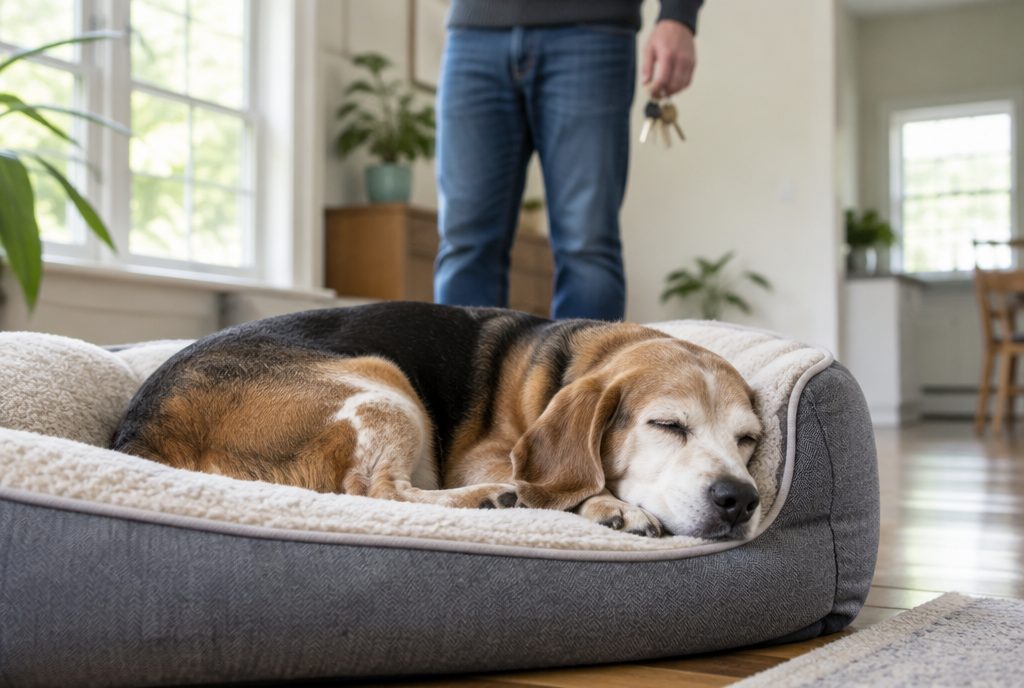
- Wait until your dog is resting or asleep and facing away from you.
- Stand out of sight, a few steps behind or in the doorway. Do not walk across the floor toward them, because they can feel the vibration.
- Make a familiar sound: say their name, jingle keys, squeak a favorite toy, crinkle a treat bag or clap once. Avoid stamping or slamming doors, which they may feel rather than hear.
- Watch closely for an ear flick, a head turn, opening the eyes or waking up.
- Try again on another day with a different sound and from the other side, so you can tell if one ear seems weaker.
Merck explains that a sleeping dog who does not wake to a sound that does not activate the other senses is a suggestive sign of deafness in both ears. Home tests have real limits, though. They cannot pick up deafness in one ear, dogs may react to vibration or air movement instead of sound, stressed dogs may freeze rather than respond, and a dog may stop reacting to a sound simply because it is no longer new.
Tip
Keep a short note on your phone each time you test: the date, the sound you used and how your dog reacted. A simple record shows your vet whether the change is slow and steady or sudden, which helps them narrow down the cause.
When do at-home tests indicate you should see the vet?
Home checks are helpful, but they are not a diagnosis. If your dog repeatedly fails to respond to sounds they once knew well, book a vet visit to look for a treatable cause, such as wax, an ear infection or a damaged eardrum. A vet visit is especially important when:
- Your dog suddenly stops responding to sound.
- There is a head tilt, circling, imbalance or pain.
- Your dog scratches or shakes their head, or an ear smells or has discharge.
- Your dog seems confused, unusually jumpy or different in their daily routine.
- Your dog recently started a new medicine or ear cleaner, or had a procedure under anesthesia.
While you wait for the appointment, use visual signals, avoid startling your dog and keep them on a leash outdoors.
How Do Veterinarians Diagnose Deafness in Dogs?
A veterinarian usually starts by watching how your dog responds to sounds and by looking into the ear canal with an otoscope. This can spot wax, inflammation, blockages, a damaged eardrum or an ear infection that may affect hearing. Merck notes that a vet may also use x-rays, a CT scan or an MRI to look for the cause, especially when hearing loss came on later in life.
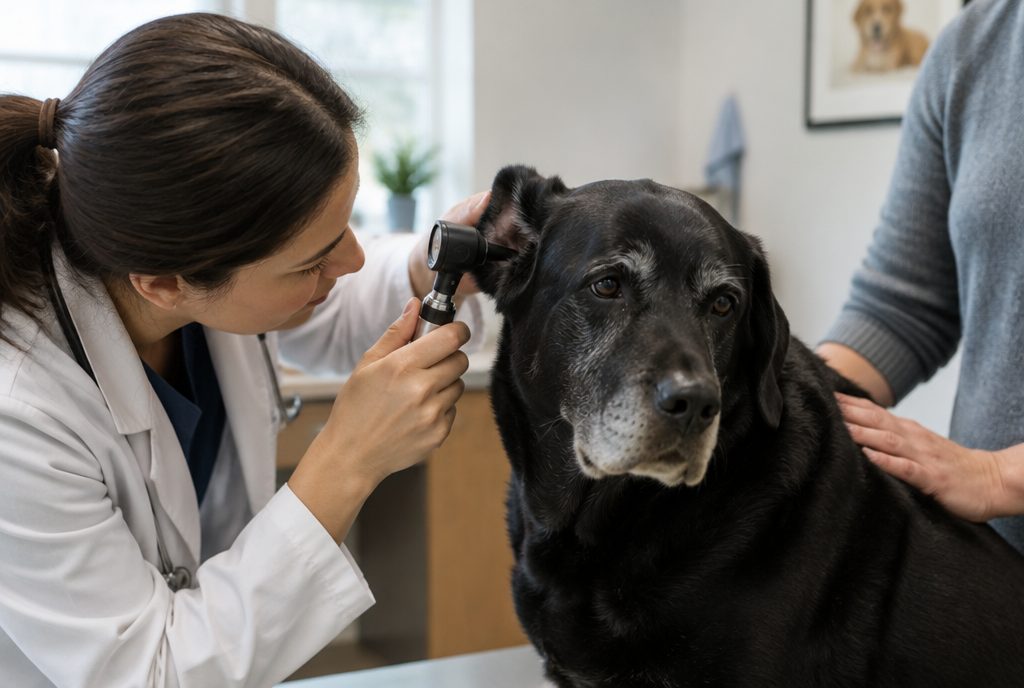
To confirm deafness and check each ear separately, vets use the brainstem auditory evoked response (BAER) test. According to LSU's School of Veterinary Medicine, small electrodes record the electrical activity of the inner ear and hearing pathways while sounds are played into each ear. A deaf ear shows an essentially flat line. The whole test usually takes 10 to 15 minutes, sedation is usually not needed, and pain from the electrodes is rare. BAER testing is offered mainly at referral and specialty centers, so ask your vet where the nearest one is.
| Test or step | What it shows |
|---|---|
| Sound response exam | A rough sense of hearing, but it cannot detect deafness in one ear |
| Physical exam and otoscope | Wax, infection, inflammation, blockage or a damaged eardrum |
| X-rays, CT or MRI | Problems deeper in the ear or skull, such as middle ear disease or a growth |
| BAER test | Confirms whether each ear can hear, in about 10 to 15 minutes |
Which Dog Breeds Are More Likely to Experience Deafness?
Some dogs are born deaf or lose their hearing in the first weeks of life because of inherited genes. Merck reports that this inherited, congenital deafness affects more than 100 dog breeds. It is especially common in breeds that carry the piebald or merle coat color genes, and a 2012 review in Veterinary Clinics of North America found that dogs with blue eyes are more likely to have hereditary deafness than brown-eyed dogs.
- Piebald breeds often affected: Dalmatian, Dogo Argentino, Catahoula Leopard Dog, Bull Terrier, Australian Cattle Dog, English Setter, English Cocker Spaniel, Boston Terrier and Parson Russell Terrier.
- Merle breeds: dogs carrying the merle gene, especially those with a lot of white.
- Hearing loss in midlife: inherited deafness that starts in adulthood has been documented in Border Collies and Rhodesian Ridgebacks.
For most senior dogs, though, age matters more than breed. Any dog can develop age-related hearing loss, and dogs who spent years around loud noise, such as hunting dogs, may lose hearing sooner. If your dog belongs to a higher-risk breed or has a lot of white in their coat, mention it to your vet. A dog who was deaf in one ear from birth may have gone unnoticed for years.
How Should I Adjust My Care for a Senior Deaf Dog?
Once hearing fades, your dog needs care built around safety and predictability. Merck points out that deaf dogs are more easily startled, which can raise the risk of a startle bite, and they are less protected from dangers such as cars. With a few changes, your home can help them use sight, touch and routine instead. Our guide to making your home senior pet friendly has more ideas for older dogs.
Safety-proofing your home for a deaf dog's needs
- Keep your dog on a leash outside unless the area is securely fenced. A deaf dog cannot hear a car, a bike or you calling them back.
- Keep ID tags and microchip details up to date, and consider a tag that says "I am deaf."
- Build steady routines around meals, walks and rest so your dog knows what comes next.
- Get your dog's attention with a wave, by flicking a light on and off, or by gently tapping the floor, instead of calling from another room.
- Walk into your dog's line of sight before you touch them, and avoid approaching silently from behind.
- Ask visitors and children to let the dog see them first.
- Protect any hearing that is left. Keep your dog away from fireworks and other very loud noise, since noise damage adds up.
Waking up a deaf dog safely: Helpful tips and routines
A sleeping dog who cannot hear you may startle if touched suddenly. That surprise can be stressful, especially for a senior dog with sore joints. The safest way to wake a deaf dog is gently and the same way every time, so the routine itself tells them it is you.
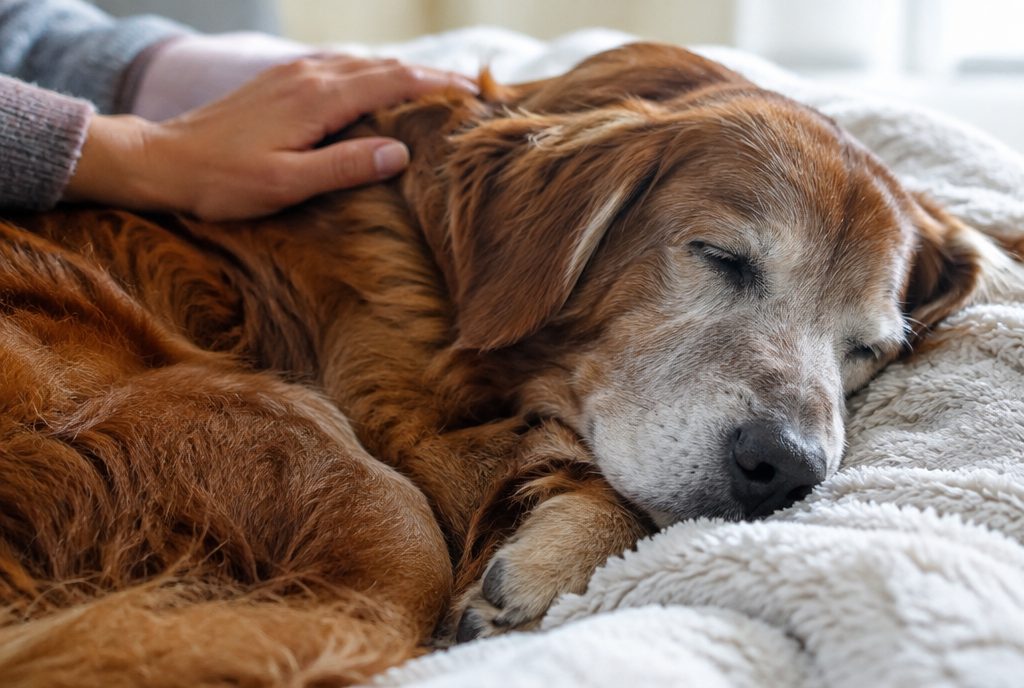
- Tap the floor or the edge of the bed nearby first, so the vibration gives a soft warning.
- Hold your hand near their nose so your scent reaches them before your touch.
- Touch the same spot each time, such as the shoulder or back, rather than the head.
- Move into view as soon as they stir, and reward calm waking with a treat.
Consistency lowers stress and helps your dog trust that being woken is a good thing.
"Your dog may not hear your voice anymore, but they still read your face, your hands and your routine. That is a language you can keep sharing."
What Are the Best Ways to Help a Deaf Dog Live a Happy Senior Life?
Dogs with hearing loss can still enjoy play, walks, affection and close family bonds. What changes most is not your dog's personality but the way you talk to each other. Merck notes that owners have used obedience hand signals and sign language successfully with deaf dogs. Keep your dog's mind busy too: sniffing games, puzzle feeders and slow "sniff walks" use the senses your dog still relies on. Our list of DIY enrichment activities for senior pets has easy ideas.
Training techniques and hand signals for deaf dogs
Training a deaf dog starts with attention, not sound. Once your dog is looking at you, hand signals can replace spoken cues very well. Senior dogs learn best with short, positive sessions.
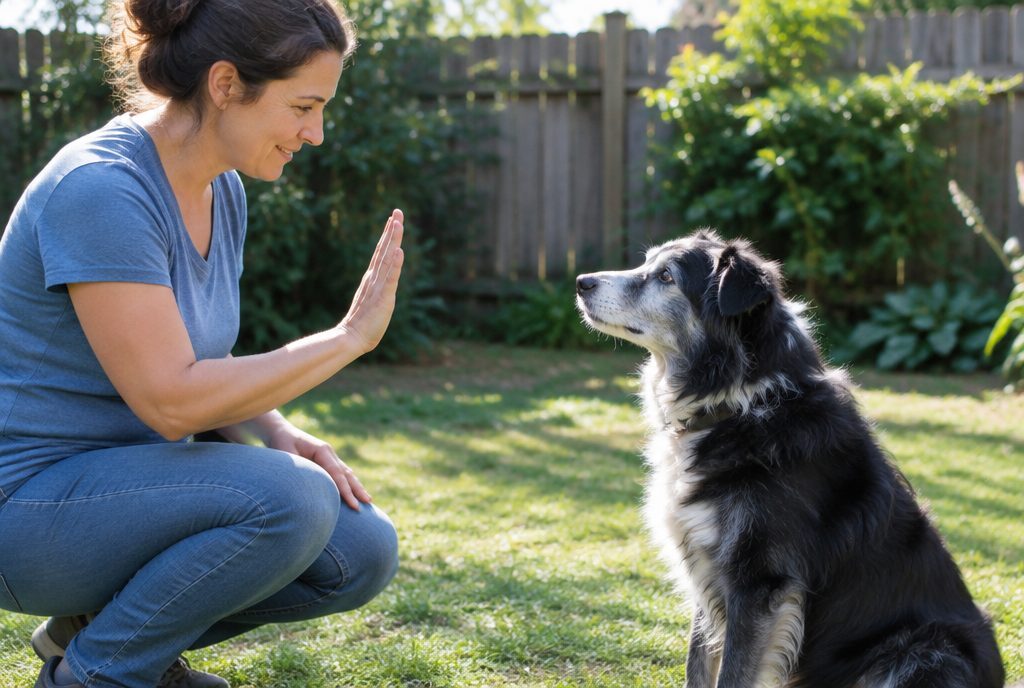
- Choose one clear hand signal for each cue and have everyone in the family use the same one.
- Pair the signal with a treat or praise every time at first.
- Pick a "good dog" marker, such as a thumbs-up or a big smile, to replace your praise words.
- Reward your dog every time they check in and look at you, so watching you becomes a habit.
- Practice in a quiet room before you try it outside.
Here are some simple signals many families use. Any signals work, as long as you are consistent.
| Cue | Example hand signal |
|---|---|
| Good dog | Thumbs-up, followed by a treat |
| Come | Arm out wide, then sweep your hand to your chest |
| Sit | Flat hand, palm up, raised from waist to chest |
| Stay or wait | Open palm facing your dog |
| Dinner or walk time | Show the bowl or the leash |
Does Hearing Loss Affect My Old Dog's Quality of Life?
Hearing loss changes how your dog moves through the world, but on its own it rarely takes away a good life. Merck notes there is no evidence that deafness itself causes pain or discomfort, and dogs who lose their hearing later in life appear to cope well. A deaf dog can still enjoy affection, food, sniffing, walks, sunshine and rest. What matters most is support: a safe home, a steady routine and a family who learns a new way to talk.
Hearing loss often arrives alongside other signs of aging, such as fading eyesight, arthritis or memory changes. It is the combination, not deafness alone, that can slowly shrink a senior dog's world. If you are unsure how your dog is really doing, our quality of life checklist can help you look at the whole picture. Honor Pet also offers one-hour virtual quality of life consultations with a licensed veterinarian, for families who want a calm, honest conversation about the road ahead.
If the time does come to say goodbye, for any reason, our veterinarians provide in-home euthanasia throughout Los Angeles and surrounding areas, so your dog can rest in their own bed with familiar smells around them. In-home euthanasia is $550, and a visit to our Comfort Center in downtown Los Angeles is $300. Your dog first receives a calming sedative so they can relax into a deep sleep, and only then is a second medication given. Afterward, gentle water cremation is available, with individual cremation from $349 and communal cremation from $180.
Worried about your senior dog?
Our veterinarians can help you understand your dog's quality of life and plan ahead with care, at home or at our Comfort Center.
Talk to Honor Pet or call (323) 515-1234
Frequently Asked Questions
Is my dog deaf or just ignoring me?
A dog who is ignoring you still reacts to sounds they care about, like a treat bag, the leash or the doorbell. A dog with hearing loss misses those too, sleeps through noises that used to wake them and may only notice you once they see you. Test with a familiar sound made out of sight while your dog is resting.
Can a dog be deaf in one ear?
Yes. This is called unilateral deafness, and it is easy to miss because the dog still hears with the other ear. The main signs are trouble working out where a sound is coming from and turning the good ear toward sounds. Home tests cannot reliably detect it, so a BAER test, which checks each ear separately, is the way to confirm it.
Can hearing loss in dogs be reversed?
Sometimes, depending on the cause. Hearing loss from earwax, a blocked or infected ear canal, a middle ear infection or a ruptured eardrum often improves once the problem is treated. Age-related hearing loss and damage from certain medicines or very loud noise are usually permanent, because the hair cells of the inner ear do not grow back.
Do hearing aids work for dogs?
Rarely. The Merck Veterinary Manual notes that clinical experience shows hearing aids have limited effect in animals. For most senior dogs, hand signals, a safe home and a steady routine help far more.
Can a deaf dog still enjoy life with their family?
Yes. Deafness is not painful, and dogs who lose their hearing later in life usually adapt well. With hand signals, gentle wake-up routines and a leash outdoors, a deaf dog can keep enjoying walks, play, food and time with the people they love.
When is hearing loss in a dog an emergency?
Call your vet promptly if hearing loss comes on suddenly or comes with a head tilt, circling, loss of balance, ear pain, head shaking or discharge from the ear. These signs can point to an inner ear infection or another problem that should be treated quickly to give the best chance of protecting the hearing that is left.
Remembering Your Dog
Every stage of your dog's life, including the quiet senior years, is worth remembering. The Honor Pet store offers keepsakes such as a clay paw print ($40), taken gently during aftercare, ink nose and paw prints ($55) and a fur clipping ($7.50), so you can keep a piece of your companion close.