
Introduction
Senior dog incontinence means your older dog leaks urine without meaning to, often as a wet spot where they have been sleeping. It is common, and the most frequent cause in older dogs, especially spayed females, is a weak urethral sphincter, which usually responds well to daily medication. Other causes include urinary tract infections, bladder stones, nerve problems and illnesses that make dogs drink and pee more, such as kidney disease, diabetes and Cushing's disease. A vet visit is the first step, because the right treatment depends on the cause, and most incontinent dogs can stay comfortable, clean and happy at home.
Key Takeaways
- Urinary incontinence in senior dogs often shows up as wet spots on bedding after sleep or rest. Your dog is not misbehaving and usually does not know it happened.
- The most common cause is urethral sphincter mechanism incompetence (USMI), a weak seal at the bladder outlet. It is most common in large, spayed female dogs.
- Infections, bladder stones, nerve and spine problems, and diseases that cause heavy drinking can all cause or worsen leaking.
- Two medicines approved for dogs, phenylpropanolamine and estriol, are the main treatments for USMI, and most incontinent dogs respond well to treatment.
- Never cut back your dog's water unless your vet tells you to. Keep the skin clean and dry to prevent urine scald.
- Incontinence on its own is rarely a reason to say goodbye. It matters most when it comes with pain, repeated infections or a wider decline.
Finding urine where your dog was just sleeping can feel upsetting, but it is a common problem in older dogs and is often very manageable. Many owners first notice small puddles, damp fur on the back legs, or bedding that needs washing more often, and then wonder whether this is just old age. It is worth a vet visit. This guide explains what causes old dog incontinence, how to tell it apart from other toilet problems, what your vet will check, the treatments that work, and how to keep your dog comfortable at home.
What Causes Incontinence in Senior Dogs?
In senior dogs, incontinence is a symptom, not a diagnosis. The Merck Veterinary Manual splits urination problems into two groups: dogs that cannot store urine properly, so it leaks out, and dogs that cannot empty the bladder well, so it overfills and then dribbles. Illnesses that make a dog drink and pee much more can also lead to accidents that look like incontinence.
Common medical reasons for dog incontinence in older pets
For many older dogs, the most common cause is urethral sphincter mechanism incompetence, usually shortened to USMI. The muscles that keep the urethra closed do not seal tightly enough, so urine slips out, especially when a dog is relaxed or asleep. According to the Merck Veterinary Manual's professional chapter, USMI is linked to low sex hormones after neutering, most often affects spayed female dogs, and may become more obvious in middle-aged and older dogs, when other health problems add to it.
| Cause | What it can look like |
|---|---|
| Weak urethral sphincter (USMI) | Wet patch where your dog slept; normal peeing otherwise |
| Urinary tract infection or bladder inflammation | Sudden urgency, small frequent pees, accidents, sometimes blood or odor |
| Bladder stones, growths or scar tissue | Straining, a thin or slow stream, dribbling from an overfull bladder |
| Spine or nerve disease | Leaking with weak back legs, a bladder that is hard or too easy to empty |
| Kidney disease, diabetes or Cushing's disease | Drinking and peeing a lot more, so the bladder fills fast |
| Cognitive changes (dog dementia) | Peeing indoors fully and on purpose, as if house training was forgotten |
If your dog is drinking more than usual, read our guides to kidney disease in dogs, Cushing's disease and diabetes in dogs. Leaking together with wobbly back legs can point to a spine problem such as IVDD or degenerative myelopathy.
Are some breeds or sexes more prone to senior dog incontinence?
Yes. Spayed female dogs are the group most often affected by USMI. Merck's chapter on incontinence drugs puts the rate at 11% to 20% in large-breed spayed females, though intact females and male dogs can be affected too. A 2017 study of 163 spayed female dogs with USMI in the Journal of Veterinary Internal Medicine notes that USMI is most common in dogs weighing more than 20 kg (about 44 lb). In older dogs, other illnesses can make a weak sphincter more obvious.
How Can I Tell If My Dog Is Experiencing Urinary Incontinence?
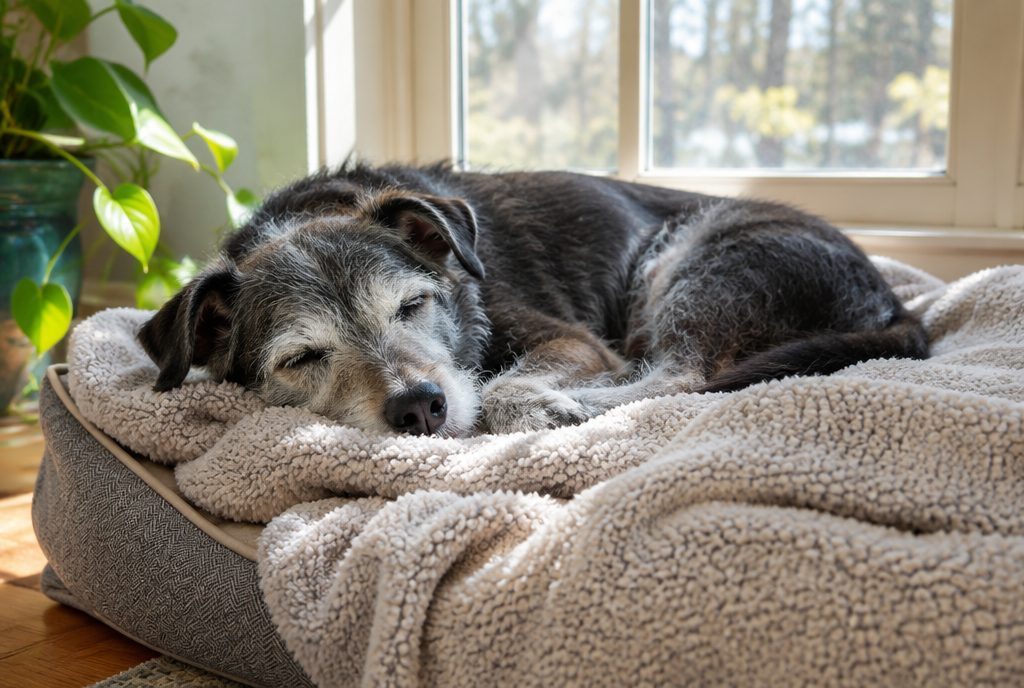
The classic sign is urine your dog does not seem to know about. You may find a wet patch on the bed or floor after your dog has been sleeping or resting, or notice drips as they walk. Merck notes that the fur around the vulva or penis can stay wet, and the skin there can become red and sore from urine scald.
That pattern matters. True incontinence is passive: the urine leaks out. That is different from a dog who squats and pees indoors on purpose, which points more toward an infection, increased thirst, anxiety or cognitive changes. Telling your vet exactly when and how the urine appears helps them narrow it down.
Key signs of incontinence in dogs versus other health issues
| What you see | What it may point to |
|---|---|
| Wet spot after sleeping, otherwise normal peeing | A storage problem such as USMI |
| Frequent squatting, straining, tiny amounts | Infection, stones or a blockage. A dog that strains and passes nothing is an emergency |
| Big puddles and a water bowl that empties fast | Increased thirst from kidney disease, diabetes or Cushing's disease |
| Licking the genital area, red skin, a strong urine smell | Urine scald or infection |
| Peeing indoors on purpose, seeming confused | Cognitive changes or anxiety rather than leaking |
If house soiling comes with confusion, pacing at night or getting stuck in corners, read our guide to nighttime restlessness and cognitive changes.
Call your vet right away if
your dog strains to pee and little or nothing comes out, cries when peeing, has blood in the urine, or suddenly cannot walk on the back legs. Merck notes that a completely blocked urethra is an emergency. A dog that is leaking and also vomiting, very tired or not eating needs to be seen the same day.
What tests will a veterinarian use to diagnose incontinence in older dogs?
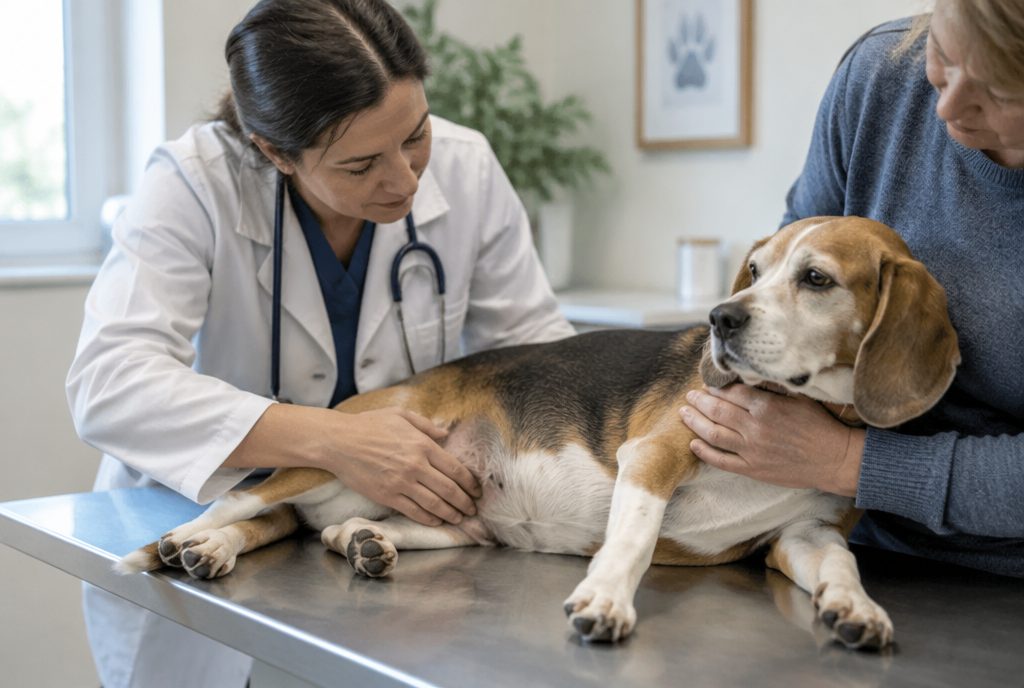
Diagnosis starts with your story and a careful exam. Your vet will ask when the leaking happens, whether your dog is drinking more and whether peeing looks painful, and may want to watch your dog pee. A neurological exam checks the nerves that control the bladder.
- Urinalysis and urine culture to look for infection, blood, crystals and how concentrated the urine is.
- Blood tests to check for kidney disease, diabetes and other illnesses that increase thirst.
- X-rays or ultrasound to look for stones, growths and the shape of the bladder.
- Cystoscopy, a camera look inside the bladder and urethra, in some cases.
For USMI, Merck explains that the diagnosis is often presumptive: once tests rule out other causes, a typical history and a good response to treatment confirm it.
Tip
Before the appointment, keep a 3-day diary: when you find wet spots, how much your dog drinks, and how often they go outside. Measuring the water you put in the bowl each morning gives your vet a useful number. If you can, collect a little urine in a clean container the same morning, and ask your vet first how they want it brought in.
How Is Incontinence in Dogs Treated and Managed?
Treatment depends on the cause. An infection is treated with antibiotics, stones may need a special diet or removal, and illnesses such as diabetes or Cushing's disease are treated directly. When USMI is the cause, medication works well for most dogs.
Medications and surgery your vet may suggest
Merck lists two medicines approved for dogs with USMI: phenylpropanolamine (often called PPA), which tightens the urethral sphincter, and estriol, an estrogen for spayed female dogs. Diethylstilbestrol is an older estrogen that is now available only through compounding pharmacies. If one medicine is not enough, vets sometimes combine PPA with an estrogen. The outlook is good: a 2019 review in Veterinary Clinics of North America notes that most causes of incontinence are easily diagnosed and most dogs respond to the right treatment. For USMI, treatment is usually lifelong, with regular vet check-ups.
| Treatment | When it is used |
|---|---|
| Phenylpropanolamine (PPA) | Weak sphincter (USMI) in female and male dogs |
| Estriol or other estrogen | USMI in spayed female dogs, alone or with PPA |
| Antibiotics | A confirmed urinary tract infection |
| Medicine to calm the bladder | An overactive bladder that squeezes too often |
| Collagen injections or an artificial urethral sphincter | USMI that does not respond to medication |
| Help emptying the bladder | Nerve damage that stops the bladder emptying; owners can be taught to express it |
Never give your dog human bladder medicines or supplements without your vet's advice.
Daily care, skin care and home changes
Home care matters because even mild leaking can irritate the skin and disturb your dog's rest. Start with simple changes, and do not cut back your dog's water unless your vet tells you to, because limiting water can make other problems worse, especially in dogs with kidney disease.
- More trips outside: first thing in the morning, after meals and naps, and last thing at night.
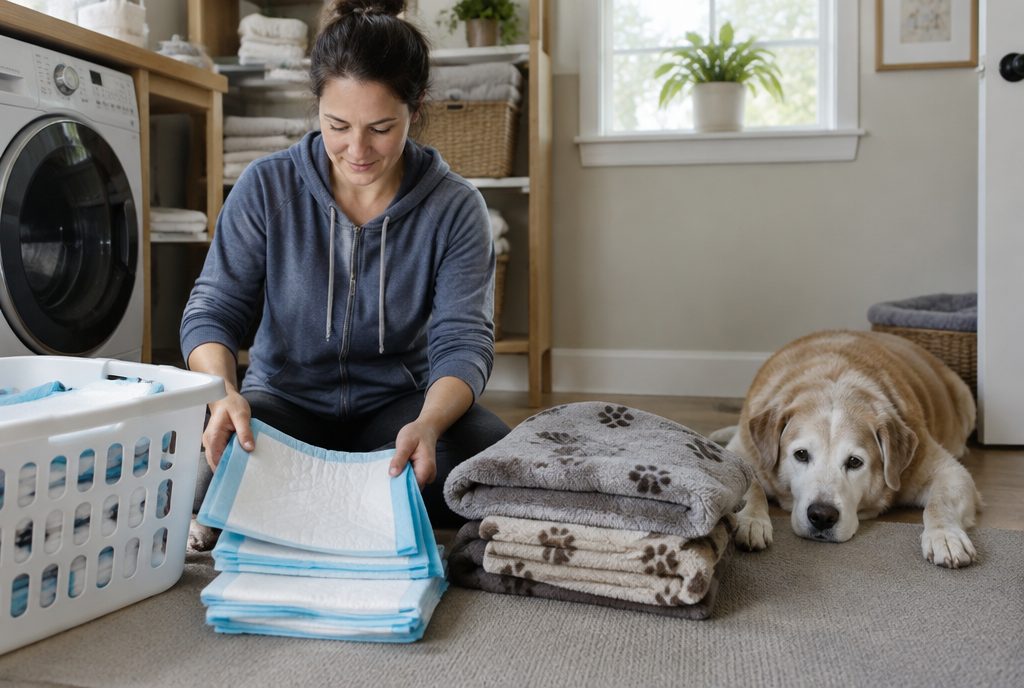
- Waterproof bedding: put a waterproof cover or washable pad under a soft top layer, and keep spares so you can swap them quickly.
- Diapers or belly bands: they help on furniture or overnight, but change them often so urine does not sit on the skin.
- Skin care: gently wipe and dry the back legs and genital area each day. Keep the fur there trimmed short. Tell your vet about any redness or sores.
- Easier access outside: ramps, a closer door or a pee pad near the bed help dogs with stiff joints. Our guide to making your home senior pet friendly has more ideas.
- Stay kind: never scold a dog for leaking. They cannot control it, and stress can make house soiling worse.
"A leaking dog is not a naughty dog. With the right treatment and a few washable layers, most older dogs stay clean, comfortable and close to their families."
When Should I Worry About My Old Dog's Incontinence?
See your vet soon if leaking starts suddenly, gets worse, or comes with straining, pain, blood in the urine, increased thirst, weakness in the back legs, or sore skin. Older dogs can develop treatable problems quickly, and early care helps prevent bladder, kidney and skin complications.
Incontinence on its own is rarely a reason to say goodbye. It becomes part of a quality of life question when it comes with ongoing discomfort, infections that keep returning, painful skin sores, loss of mobility or several serious illnesses at once. If you are unsure how your dog is really doing, our quality of life checklist can help you look at the whole picture. Honor Pet also offers one-hour virtual quality of life consultations with a licensed veterinarian.
When the time does come, our veterinarians provide in-home euthanasia throughout Los Angeles and surrounding areas, so your dog can rest in their own bed. In-home euthanasia is $550, and a visit to our Comfort Center in downtown Los Angeles is $300. Your dog first receives a calming sedative so they can relax into a deep sleep, and only then is a second medication given. Afterward, gentle water cremation is available, with individual cremation at $349, $399 or $449 and communal cremation at $180, $205 or $232, depending on your dog's weight.
Worried about your senior dog?
Our veterinarians can help you understand your dog's quality of life and plan ahead with care, at home or at our Comfort Center.
Talk to Honor Pet or call (323) 515-1234
Frequently Asked Questions
Why is my old dog leaking urine while sleeping?
Leaking during sleep is the classic sign of a weak urethral sphincter (USMI). When your dog is fully relaxed, the muscles that keep the bladder outlet closed do not hold tightly enough, so urine slips out. It is most common in spayed female dogs. Infections and other bladder problems can cause it too, so ask your vet to check.
Can incontinence in dogs be cured?
Sometimes. Incontinence caused by a urinary tract infection or bladder stones often stops once the problem is treated. USMI usually is not cured, but it is controlled: many dogs stay dry on daily medication, and collagen injections or surgery can help dogs that do not respond.
Can certain medications make my senior dog incontinent?
Yes. Some medicines, such as steroids, make dogs drink and pee more, which can make leaking more likely or more noticeable. Do not stop any prescribed medicine on your own. Tell your vet about every medicine and supplement your dog takes so they can look for a link.
Do dog diapers help with incontinence?
Diapers and belly bands keep floors and furniture dry, but they do not treat the cause. Change them often, because urine trapped against the skin can cause painful scalding. Most dogs do best with diapers as a backup to medication and regular potty breaks.
Should I limit my incontinent dog's water?
No, not unless your vet advises it. Older dogs, and especially dogs with kidney disease, need plenty of water. Instead, offer more frequent potty breaks, including one last thing at night, and use waterproof bedding.
Is incontinence a reason to put an old dog down?
Usually not. Incontinence alone is often manageable with treatment and good home care. It becomes part of a quality of life decision when it comes with pain, repeated infections, skin sores that will not heal, loss of mobility or several serious illnesses, and good days are becoming rare. A conversation with your vet can help you decide.
Remembering Your Dog
Every stage of your dog's life, including the quieter senior years, is worth remembering. The Honor Pet store offers keepsakes such as a clay paw print ($40), taken gently during aftercare, ink nose and paw prints ($55) and a fur clipping ($7.50), so you can keep a piece of your companion close.